Reading, vocabulary and proof, for English language schools.
iRead teaches English through stories students love — with vocabulary games, CEFR quizzes, and live sessions your team can run school-wide in minutes. Track every student's growth. Show every parent the progress.
Students improve. Schools gain.
Students improve
- Vocabulary grows through reading, then sticks through memory-training word games
- Dedicated quizzes sharpen how they use English — level by CEFR level
- Every story teaches a moral: honesty, courage, kindness, perseverance
- Flexible session choice means they attend more story sessions, not fewer
Schools gain
- Dashboards and CEFR progress you can show parents and your board
- Fewer sessions to run — the optimizer fills classes and cuts teacher workload
- A public school page that markets your reading culture for you
- Inter-school competitions that put your students on a bigger stage
Read. Play. Quiz. Progress.
Choose a pack of graded readers, schedule the sessions, and iRead automatically enrols students, tracks attendance, and generates a new game every day from that story's vocabulary.
Read the story
CEFR-levelled stories in live sessions or self-study — global packs or your school's own.
Play the words
Four word games turn each story's vocabulary into memory training.
Take the quiz
Comprehension and usage quizzes confirm the level — and surface the moral.
See the progress
Teachers, parents, and leaders watch vocabulary and CEFR levels climb.
Six doors into iRead. Pick the one your school needs first.
Each one takes you deeper into one part of the program — content, delivery, motivation, character, retention, and proof.
Classroom-ready or homemade
Instantiate iRead's global packs in one click, or publish your school's own stories.
Explore packsLive online sessions
Schedule many sessions per unit; students pick one. Attendance goes up, workload goes down.
See the schedulerDaily competition
Global packs let students compete daily with other schools; school packs keep it in-house.
Join the daily runValues in every story
Students finish each story with new words and a lesson worth keeping.
See the valuesMemory-training games
Four games designed for memorization — retention, not just exposure.
Play the gamesYour public school page
Packs, stories, and achievements published for parents to see.
See a school pageDeciding for a whole school?
Results, efficiency, and reputation — the leadership view of iRead.
See what a pack actually looks like.
Every pack is a CEFR-levelled set of graded readers — pulled from the global iRead library, or built entirely from books your school already owns. Several packs can run at once, for different classes or levels.
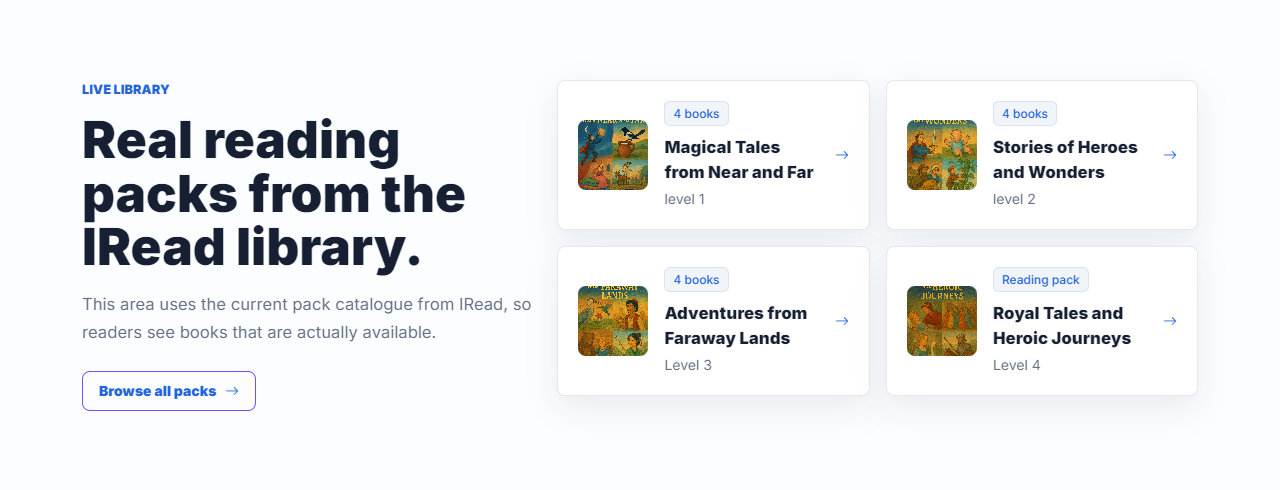
A real screenshot — packs currently live in the iRead library.
Global for the big stage, school packs for your curriculum
Global packiRead's library
- Instantiate in one click — stories, games and quizzes included, A1–C2
- Students join the daily run against peers across every school using the pack
- Values-tagged stories, curated and levelled by iRead
School packYour curriculum, your stories
- Build stories around your school's own annual or termly curriculum
- Publish local, cultural, or subject-specific content your global library can't provide
- The daily game runs just for your students, class against class
- Your identity, on your public school page
Five ways your students play with the words they just read.
Every 24 hours, iRead generates 5 games straight from the current story's vocabulary — no admin setup required.
Think Word
Guess today's secret word, Wordle-style — five tries, with color hints steering every next guess.
From story to word: The word is always pulled straight from the story currently being read, so every guess is another rep on a word the student has already met in context — not a random flashcard.
Bee Genius
Build as many words as you can from today's letters — every word must use the center letter.
From story to word: The letters come straight from the story just read, so every word built is another rep on vocabulary the student has already met in context.
Intellect Link
Find the hidden groups of related words tucked inside a letter grid, Strands-style.
From story to word: Every word in the grid comes from the same story, so spotting the connections between them reinforces how those words relate to each other — not just what each one means on its own.
Word Explorer
Hunt down today's vocabulary hidden inside a letter grid before time runs out.
From story to word: Every word students find was pulled from the story they just read, so finding it is one more spaced repetition of that vocabulary in its written form.
One quiz a day, built from the story itself.
Every quiz question is generated from the story a student just read — so it checks real comprehension and grammar, not just word lists.
Real-sentence English usage
Questions are built from actual sentences in the story, so students practise using words the way they're really used — not matching definitions in isolation.
Grammar tied to what they just read
Each quiz surfaces the grammar structures that actually appear in that story — tense, phrasal verbs, question forms — instead of testing rules in the abstract.
Comprehension and story morals
Beyond vocabulary, quizzes ask what happened and why it mattered — plot, character choices, and the lesson the story was actually making.
A daily habit, not a test to study for
Quizzes auto-run after every session and feed the same mastery system as the games, so review happens automatically instead of needing to be scheduled.
A framework your teachers already trust.
Every story, quiz, and game is levelled to the Common European Framework of Reference for Languages — the same six-band scale used across EFL/ESL curricula worldwide, so cross-school competition only ever matches students at the same level.
A1 · Beginner
First words and simple phrases — picture-supported stories and everyday vocabulary.
A2 · Elementary
Short, simple stories about familiar topics, using high-frequency vocabulary.
B1 · Intermediate
Longer narratives students can follow independently, mixing everyday and academic vocabulary.
B2 · Upper-Intermediate
More complex plots and vocabulary, building toward fluent, independent reading.
C1 · Advanced
Sophisticated texts with nuanced vocabulary and idiomatic language.
C2 · Mastery
Native-level texts across genres, for students ready to read anything.
Every story is levelled, not guessed
Vocabulary and quizzes are mapped to CEFR bands, so a "B1" story means the same thing whichever pack it came from.
Fair, level-matched competition
Cross-school leaderboards only ever match schools running the same CEFR level — never a mismatch.
Four steps. No IT project.
There's no lengthy rollout. Here's exactly what adopting iRead involves for your team.
1 Book a demo
We walk your team through a real pack, a session, and a full day of games — the actual product, not slides.
2 Choose your first pack
Pick a CEFR-levelled pack from the global library, or build one from books your school already owns. Set roles for admins, teachers, and assistants.
3 Schedule your first session
Online or in-school — students self-enrol, and attendance tracks itself from the very first session.
4 Go live
Daily games, quizzes, and the cross-school leaderboard start running automatically — no extra setup after day one.
One library, every part of the program.
Deeper guidance for English coordinators, teachers, and school leaders — each links onward to the matching part of the program.
Reading Packs & Programs for Schools
Ready-made packs or your own stories: choosing, launching, and budgeting a schoolwide English reading program.
Read the guideExtensive Reading with Levelled Stories
Levelled stories, audio read-along, and the research behind reading a lot at a comfortable level.
Read the guideCEFR & English Reading Levels
CEFR bands explained and mapped to Lexile, Cambridge, and IELTS, with placement tests and vocabulary targets per level.
Read the guideVocabulary Games & Word Retention
Word games, spaced repetition, and the repeated meetings with a word that make new vocabulary stick.
Read the guideReading Quizzes & Comprehension
Comprehension questions, grammar in context, and short daily quizzes built from the story itself.
Read the guideLive Reading Sessions, Online & In School
Scheduling, attendance, and blended delivery for live reading sessions, online and in school.
Read the guideReading Competitions & Motivation
Daily runs, inter-school competitions, and rewards that build a lasting reading culture.
Read the guideValues & Life Lessons Through Stories
Character education and social-emotional learning built around story discussion.
Read the guideMeasuring & Proving Reading Progress
Dashboards, term reports, and ROI evidence for teachers, school leaders, and parents.
Read the guideSchool Reputation & Public Reading Pages
Showing parents what your students read and achieve, and what that does for your school's reputation.
Read the guideWriting & Narrating Stories for Learners
Writing and narrating stories for English learners, level by level.
Read the guideWhat school admins ask before they book a demo.
Does iRead replace our English curriculum?
No — iRead runs alongside your existing curriculum as a daily reading, vocabulary, and practice layer. Your teachers keep teaching; iRead handles the daily repetition and games.
What do students need to use it?
A browser and an internet connection — no software to install. Sessions can run online or in your existing classroom, on whatever devices your school already has.
Can we use books our school already owns?
Yes. A pack can come from the global CEFR-levelled library, or be built entirely from your own school's books.
Who can see our students' data?
Only your school's own admins, teachers, and assistants. Every account is scoped to your school — nothing is shared across schools.
How much does iRead cost?
Pricing depends on your school's size and the CEFR levels you need. Book a demo and we'll put together a quote for your school.
What happens after we book a demo?
We'll walk your team through a real pack, a session, and a full day of games — then help you configure and launch your first pack.
See what your students will do on day one.
Book a short call. We'll walk your team through a pack, a session, and the daily games — then help you launch your first pack.